
When engineers begin developing a new rubber component, discussions often revolve around dimensions, tolerances, hardness, or production volume. While these factors are certainly important, they are only part of the equation. The long-term performance of a rubber product is determined much earlier during the development of the rubber compound itself.
If you have ever wondered what is rubber compounding, the simplest answer is that it is the process of transforming raw rubber into a high-performance engineering material by combining it with carefully selected ingredients. However, for OEM manufacturers, rubber compounding is far more than a mixing operation. It is a critical stage where material properties are engineered to meet the specific demands of an application.
Whether the final product is an automotive weatherstrip, an oil-resistant gasket, a vibration isolator, or a custom molded rubber part, its ability to perform under real operating conditions depends largely on how the compound was formulated. This is why leading manufacturers invest significant engineering resources into compound development long before production tooling is built.
Understanding Rubber Compounding
Natural rubber and synthetic elastomers possess inherent flexibility, but on their own they cannot satisfy the demanding performance requirements of modern industries. Raw rubber generally lacks the durability, chemical resistance, thermal stability, and mechanical strength needed for automotive, industrial, medical, and electronic applications.
Rubber compounding is the engineering process of blending a base elastomer with fillers, curing agents, processing aids, antioxidants, plasticizers, and other additives to create a material with precisely controlled properties.
Rather than producing a generic material, the goal is to develop a compound that performs reliably under specific operating conditions. For example, an automotive door seal requires excellent resistance to ozone, ultraviolet exposure, and changing weather conditions. A hydraulic seal, on the other hand, must withstand prolonged contact with oil and high operating pressures. Although both products are made from rubber, the compounds behind them are fundamentally different.
This application-driven approach is what makes rubber compound manufacturing such an important part of product development.
Why Rubber Compounding Matters in OEM Manufacturing
For OEM manufacturers, selecting the right compound can have a greater impact on product reliability than many people realize.
A molded rubber part may pass dimensional inspection, yet still fail prematurely if its material cannot withstand the intended service environment. Cracking, swelling, hardening, excessive compression set, or loss of elasticity are often symptoms of an unsuitable compound rather than poor molding quality.
Experienced engineers understand that every application involves balancing multiple performance requirements. Increasing one property may influence another. A compound designed for outstanding oil resistance may sacrifice weatherability. Improving abrasion resistance may affect flexibility or processing behavior.
For this reason, rubber compounding is not about maximizing a single material property. It is about optimizing the entire performance profile based on the product's intended use.
During OEM development projects, engineering teams typically evaluate factors such as operating temperature, chemical exposure, mechanical loading, environmental conditions, expected service life, and regulatory requirements before recommending a compound. This systematic approach helps reduce development risks while improving long-term product performance.
The Building Blocks of a Rubber Compound
Although the exact formulation varies depending on the application, every rubber compound consists of several key ingredients that work together to produce the desired performance.
The first is the base elastomer, which forms the foundation of the compound. Depending on the application, engineers may choose Natural Rubber (NR), EPDM, NBR, Silicone, FKM, SBR, or another elastomer with properties suited to the operating environment.
Fillers are then added to improve mechanical strength, wear resistance, and processability. Carbon black remains one of the most widely used reinforcing fillers because it enhances tensile strength, durability, and abrasion resistance while also influencing the material's appearance. Silica and mineral fillers may also be selected depending on the performance objectives.
Plasticizers and processing oils help improve flexibility and facilitate manufacturing. Meanwhile, vulcanizing agents, such as sulfur or peroxide curing systems, enable the rubber to develop its elastic network during curing.
Other ingredients including antioxidants, antiozonants, accelerators, pigments, and specialty additives are incorporated to improve aging resistance, curing efficiency, color consistency, electrical properties, or flame resistance when required.
One important lesson learned from compound development is that these ingredients cannot simply be mixed together in arbitrary proportions. Every adjustment to the formulation influences multiple material characteristics. Developing a successful compound therefore requires both scientific understanding and practical manufacturing experience.
How the Rubber Compounding Process Works
Although the exact workflow varies among manufacturers, the rubber compounding process generally follows a structured sequence designed to ensure material consistency and repeatable production.
The process begins with selecting a formulation that matches the product's functional requirements. Engineers evaluate the application before determining the most suitable elastomer, reinforcing fillers, curing system, and processing additives.
Each ingredient is then weighed according to the approved formulation. Precision at this stage is essential because even small variations can influence curing behavior, hardness, or mechanical performance.
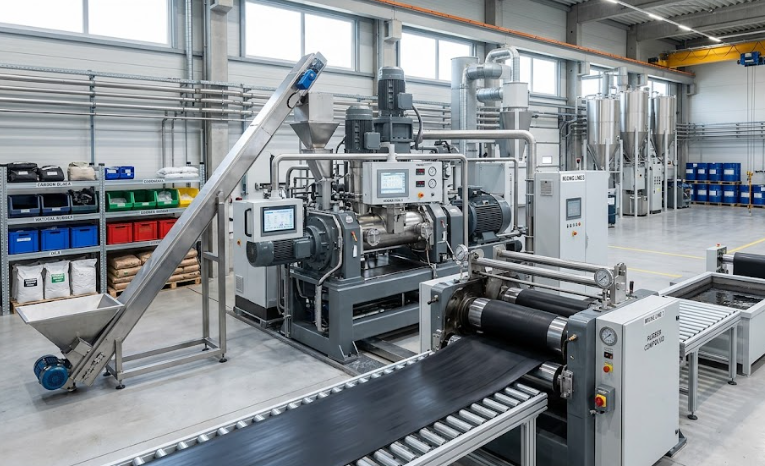
The ingredients are typically blended using an internal mixer, often referred to as a Banbury mixer. During this stage, temperature, mixing time, and rotor speed must be carefully controlled to achieve uniform dispersion of fillers and additives throughout the rubber matrix.
After internal mixing, the compound may pass through an open mill to improve homogenization, adjust temperature, and prepare the material for downstream processing. The finished compound is then formed into sheets or strips for storage or immediate production.
Before the compound reaches the molding department, quality verification is usually performed. Properties such as hardness, specific gravity, viscosity, curing characteristics, and mechanical performance may be evaluated to ensure the material satisfies specification requirements.
One practical observation from production environments is that inconsistent dispersion is one of the most common causes of quality variation. Even when the formulation itself is correct, inadequate mixing can create localized weak points that reduce the service life of the final product.
How Compound Formulation Influences Product Performance
The formulation of a rubber compound affects nearly every characteristic of the finished product.
Compression set is one of the most critical properties for sealing applications. A compound with poor compression set resistance gradually loses its ability to recover after prolonged compression, increasing the risk of leaks and reduced sealing performance.
Mechanical properties such as tensile strength, elongation, and tear resistance determine how well a rubber component withstands repeated loading or deformation during service.
Chemical resistance becomes essential when products operate in contact with fuels, lubricants, hydraulic fluids, or cleaning chemicals. Selecting an inappropriate compound can lead to swelling, softening, or material degradation over time.
Environmental resistance is equally important for products exposed to sunlight, ozone, moisture, and changing weather conditions. Automotive weatherstrips, for example, rely on compounds that maintain flexibility even after years of outdoor exposure.
Rather than optimizing a single property, engineers continuously balance these requirements to achieve reliable long-term performance without compromising manufacturability or cost efficiency.
Why Custom Rubber Compounds Are Increasingly Preferred
Standard commercial compounds may be suitable for general-purpose applications, but OEM manufacturers increasingly require materials tailored to their specific products.
Custom compounds allow engineers to optimize performance based on the application's operating environment instead of accepting unnecessary compromises. This approach often improves durability, reduces warranty risks, and supports more efficient manufacturing.
In the automotive industry, for example, a supplier may develop a compound specifically designed to satisfy an OEM's weather resistance targets while also meeting assembly requirements and production cycle times. Industrial equipment manufacturers may require compounds that withstand aggressive chemicals or repeated dynamic loading throughout extended service periods.
These examples illustrate why compound development has become an integral part of engineering rather than simply a material purchasing decision.
Choosing the Right Rubber Compound Manufacturing Partner
Developing a high-quality rubber compound requires more than access to raw materials. It depends on engineering expertise, process control, testing capability, and manufacturing consistency.
An experienced manufacturing partner should understand how material selection, formulation, mixing conditions, tooling, and molding processes interact to influence final product performance. They should also be able to evaluate application requirements, recommend suitable compounds, and support customers throughout product development rather than simply supplying material.
At Banshu Rubber Indonesia, we believe successful rubber products begin with understanding the customer's application rather than selecting a material from a catalog. Our engineering team works closely with OEM manufacturers to evaluate operating conditions, recommend suitable elastomers and compound formulations, and support product development from the earliest design stage through production. This collaborative approach helps reduce development risks while improving manufacturing consistency and long-term product reliability.
Technical Consultation & RFQ Support for Rubber Compound and Product Development
For OEM manufacturers, product designers, and engineering teams developing rubber components, selecting the appropriate rubber material and compound formulation during the early design stage is a critical factor that influences product performance, service life, application reliability, and overall production cost.
Through technical discussions during product development, critical factors such as mechanical property requirements, operating temperature, chemical exposure, environmental conditions, sealing performance, and target service life can be evaluated comprehensively before tooling design and mass production begin.
At Banshu Rubber Indonesia, we support rubber product development through a structured engineering approach. Our services include evaluating material requirements based on actual application conditions, recommending suitable elastomer types and compound formulations, conducting Design for Manufacturability (DFM) reviews for molded rubber parts, assessing potential product failure risks such as compression set, cracking, swelling, and deformation during service, and optimizing the combination of material selection, product design, tooling, and manufacturing process parameters.
This engineering-driven approach helps ensure that the selected rubber material and compound not only satisfy technical specifications but can also be manufactured consistently, deliver stable field performance, and achieve long-term cost efficiency.
Engineering and purchasing teams are welcome to submit 2D or 3D drawings, technical specifications, or product samples for technical evaluation. We also support the Request for Quotation (RFQ) process by providing recommendations on material selection, rubber compound development strategies, tooling design, and mass production readiness.
If you would like technical consultation or wish to discuss your requirements for rubber compounds, rubber mixing, or custom molded rubber parts, please contact the engineering team at Banshu Rubber Indonesia. We will be pleased to evaluate your application and recommend a manufacturing solution that aligns with your product requirements and performance objectives.