
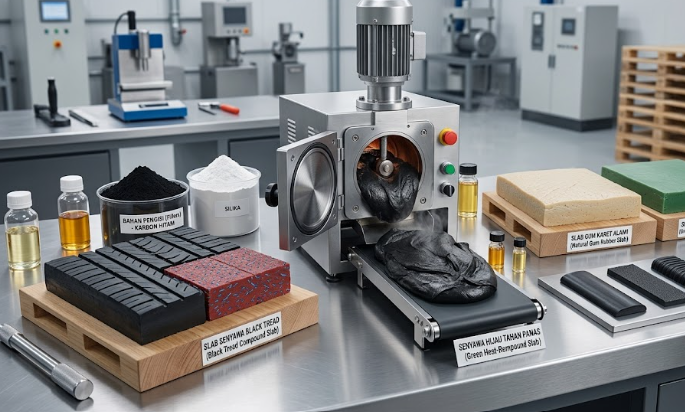
A rubber component is often one of the smallest parts in an assembly, yet it can have one of the greatest impacts on product reliability. A failed O ring can shut down a hydraulic system. A cracked gasket can cause fluid leakage that damages expensive equipment. A hardened automotive seal can allow water intrusion that leads to corrosion, electrical failures, and costly warranty claims.
In many cases, these failures are not caused by poor product design or manufacturing defects. They begin much earlier during material selection. The performance of any molded rubber part depends on how well its material has been engineered for the environment in which it will operate.
This is where rubber compound development becomes one of the most important stages of product development. Rather than relying on standard commercial materials, engineers develop custom formulations that balance mechanical strength, flexibility, thermal stability, chemical resistance, and manufacturing consistency according to the application's specific requirements.
As industries continue to demand longer service life, lighter designs, and higher operating temperatures, the importance of custom rubber and advanced material development continues to grow. Modern compound engineering is no longer based solely on experience. It combines material science, laboratory testing, simulation, and manufacturing expertise to produce reliable rubber compounds capable of performing under demanding conditions.
The Science Behind Compound Formulation
At first glance, rubber compounding may appear to be a simple process of mixing raw materials together. In reality, it is a highly controlled engineering discipline where even small adjustments to a formulation can significantly influence the performance of the finished product.
Every compound formulation begins with selecting the appropriate base elastomer. Depending on the application, engineers may choose EPDM for weather resistance, NBR for oil resistance, silicone for thermal stability, or FKM for aggressive chemical environments. However, the polymer alone does not determine the material's performance.
The final properties depend on the interaction between fillers, curing systems, plasticizers, antioxidants, processing aids, and numerous specialty additives. Each ingredient contributes to the overall balance of the compound.
To maintain formulation accuracy, the rubber industry commonly uses a measurement system known as Parts Per Hundred Rubber, or PHR. Instead of measuring ingredients as percentages of the total mixture, every component is expressed relative to one hundred parts of the base polymer.
This approach allows engineers to adjust formulations with exceptional precision while maintaining consistency across laboratory trials and mass production.
For example, increasing the amount of reinforcing filler may improve abrasion resistance but also increase hardness and reduce flexibility. Reducing processing oil may improve mechanical strength while making the compound more difficult to process during molding.
Successful compound development therefore requires balancing multiple properties rather than optimizing a single performance characteristic.
Why the Cure System Determines Long Term Performance
Among all components within a rubber formulation, the curing system has one of the greatest influences on product reliability.
During vulcanization, individual polymer chains become chemically connected through cross links, transforming soft raw rubber into a durable elastic material capable of maintaining its shape under repeated loading.
The density of these cross links directly influences many important properties including tensile strength, compression set resistance, heat resistance, and fatigue performance.
Sulfur remains one of the most widely used curing agents because it provides an excellent balance between elasticity and mechanical strength for many industrial applications. However, sulfur alone is not sufficient.
Activators such as zinc oxide enhance curing efficiency while accelerators including sulfenamides carefully control reaction speed to produce consistent cross link formation throughout the material.
Finding the correct balance is essential.
An under cured compound may exhibit poor mechanical strength and premature failure during service. Conversely, excessive cross linking may increase hardness while reducing flexibility and dynamic fatigue resistance.
From an engineering perspective, cross link density is not simply a laboratory measurement. It is one of the most important indicators of how a rubber component will perform throughout its service life.
For products exposed to repeated compression, vibration, or elevated temperatures, proper cure system design often determines whether a component performs reliably for years or requires premature replacement.
Protecting Rubber Against Environmental Degradation
Even the strongest rubber compound will gradually degrade if it is not protected against environmental exposure.
Ozone, oxygen, ultraviolet radiation, heat, and oxidation continuously attack elastomer chains during service. Without proper protection, rubber surfaces may develop fine cracks that gradually propagate until sealing performance and mechanical integrity are compromised.
Protective additives play an essential role in preventing this type of degradation.
Antioxidants reduce oxidation reactions that occur during long term thermal exposure, while antiozonants protect rubber surfaces from ozone cracking commonly experienced in outdoor applications.
Automotive weather seals provide a good example of why these additives are critical.
A door seal installed on a passenger vehicle may experience thousands of heating and cooling cycles throughout its lifetime while remaining continuously exposed to sunlight, rain, humidity, and atmospheric ozone.
Without appropriate protective chemistry, the material may harden, crack, or lose elasticity years before the vehicle reaches its expected service life.
The inclusion of these additives may seem like a small adjustment within the formulation, but their contribution to long term reliability is substantial.
Material Development Has Moved Beyond Trial and Error
Historically, developing new rubber compounds relied heavily on laboratory experience, repeated testing, and incremental formulation adjustments.
Although engineering expertise remains indispensable, today's material development process increasingly combines experimental work with computational analysis and predictive modeling.
Modern material science allows researchers to evaluate interactions between polymers, fillers, and curing systems before large scale production begins.
Simulation tools can estimate how changes in filler loading or polymer selection influence mechanical properties, thermal aging resistance, and processability.
Artificial intelligence and machine learning are also becoming valuable tools within compound development.
Rather than replacing experienced engineers, these technologies assist by analyzing extensive material databases and identifying formulation patterns that may not be immediately apparent through conventional testing.
Machine learning models can predict relationships between formulation variables and performance characteristics such as tensile strength, hardness, elongation, compression set, and chemical resistance.
This predictive approach enables development teams to narrow potential formulations more efficiently before laboratory validation begins.
It is important to recognize that digital simulation does not eliminate physical testing. Instead, it reduces unnecessary experimentation while allowing engineers to focus laboratory resources on the most promising material candidates.
Predictive Science Improves Product Reliability
One of the greatest advantages of modern compound engineering is the ability to understand material behavior before products enter production.
Predictive science combines simulation, laboratory characterization, statistical analysis, and manufacturing knowledge to identify potential weaknesses during the earliest stages of development.
Instead of waiting for field failures to reveal material limitations, engineers evaluate expected performance under simulated operating conditions.
Microstructural analysis provides valuable insight into filler dispersion, polymer interactions, and cross link distribution that cannot be observed through conventional inspection alone.
These techniques help identify potential risks associated with fatigue, thermal degradation, chemical attack, and long term dimensional stability.
For OEM manufacturers, this proactive approach offers significant advantages. Products reach production with greater confidence. Engineering revisions become less frequent. Warranty risks are reduced.
Most importantly, customers receive products designed for long term reliability rather than minimum specification compliance.
In many development projects, the objective is no longer to create a compound that simply passes laboratory testing. The objective is to develop a material capable of maintaining stable performance throughout years of real operating conditions.
This philosophy has become increasingly important as automotive, industrial, and infrastructure applications demand higher durability while operating in more challenging environments than ever before.
Reliable products are rarely the result of a single engineering decision. They are the outcome of hundreds of carefully evaluated choices made during material development, formulation design, processing, validation, and manufacturing.
That is precisely why rubber compounds continue to evolve. As performance expectations increase, compound engineering must evolve alongside them to provide materials that support safer, longer lasting, and more dependable products.