
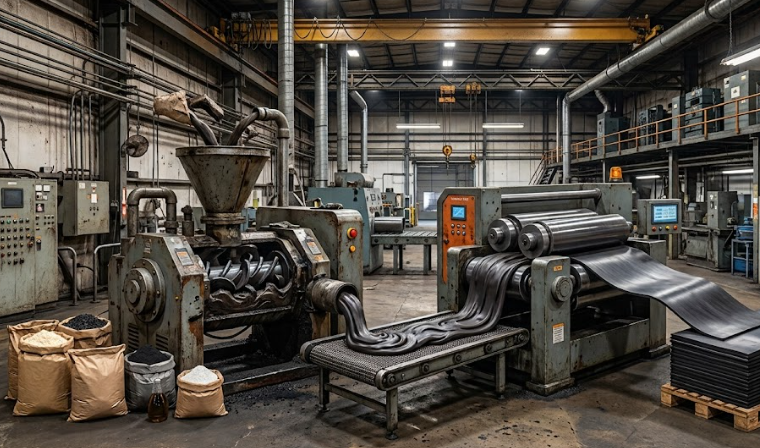
Every high-performance rubber product begins long before molding or vulcanization. It starts with a carefully engineered rubber mixing process that transforms raw polymers and additives into a homogeneous compound capable of delivering consistent mechanical properties. Whether manufacturing automotive seals, industrial gaskets, vibration isolators, or medical components, the quality of the compound ultimately determines the reliability of the finished product.
Rubber mixing is often considered the heart of rubber manufacturing because it directly influences tensile strength, elongation, hardness, compression set, chemical resistance, and long-term durability. Even minor inconsistencies during compounding can create defects such as surface cracking, pinholes, poor dispersion, uneven texture, or premature product failure after installation.
The discipline has evolved significantly since the early wooden mixing mills introduced during the 1820s. What began as a labor-intensive operation has become an engineering-driven manufacturing process supported by computerized internal mixers, automated ingredient weighing, real-time temperature monitoring, and laboratory validation. Today, successful rubber compounding combines material science, process engineering, and statistical quality control to produce compounds that meet increasingly demanding global manufacturing standards.
Understanding the Raw Materials Behind Every Rubber Compound
Every rubber compound begins with a formulation developed to achieve a specific balance of physical and chemical properties. Engineers rarely rely on a single ingredient. Instead, they design formulations where every material contributes to the final performance.
The base polymer serves as the foundation of the compound. EPDM is commonly selected for excellent weather, ozone, and heat resistance, making it suitable for automotive weatherstrips and outdoor sealing applications. Nitrile Rubber (NBR) is preferred where oils and fuels are present, while Silicone Rubber offers exceptional thermal stability and flexibility across a broad operating temperature range, making it valuable in medical, food processing, and electronics applications.
However, polymers alone cannot deliver the required performance. Fillers such as carbon black improve tensile strength, abrasion resistance, and UV durability, while silica enhances rolling resistance and dynamic performance in specialized applications. Process oils improve compound processability, antioxidants extend service life, and curing systems consisting of sulfur, peroxide, crosslinking agents, and accelerators determine how the material develops its final mechanical properties during vulcanization.
Equally important is the mixing sequence itself. Experienced compound engineers understand that ingredient addition is both an art and a science. Depending on the formulation, manufacturers may apply a "right side up" or "upside down" mixing scheme, changing when fillers, oils, curatives, and polymers enter the mixer. Proper sequencing improves filler dispersion, reduces unnecessary heat generation, shortens mixing cycles, and minimizes compound variation between production batches.
The Mechanics of the Rubber Mixing Process
Modern rubber manufacturing primarily relies on internal mixers such as Banbury or Bolling mixers because they generate the high shear forces required to disperse fillers throughout the polymer matrix efficiently. Inside the enclosed mixing chamber, two counter-rotating rotors continuously compress, stretch, fold, and shear the compound while hydraulic ram pressure maintains consistent material contact with the rotors.
Unlike traditional open mills, an internal mixer operates within a controlled environment where temperature, rotor speed, chamber pressure, and mixing time can all be precisely monitored. Most production cycles are completed within approximately five to seven minutes, enabling high-volume manufacturing while maintaining excellent batch consistency. The enclosed system also reduces airborne dust and improves workplace cleanliness compared to open milling operations.
Open mills continue to serve valuable roles despite advances in internal mixing technology. They remain useful for laboratory-scale development, prototype formulations, color adjustments, small production batches, and reclaiming rubber materials. Because operators have direct visual access to the compound, open mills offer greater flexibility during experimental development, although they require considerably more operator experience.
Achieving a high-quality compound depends on balancing two fundamental mixing principles: dispersion and distribution. Dispersion refers to breaking filler agglomerates into smaller particles, while distribution ensures those particles are evenly spread throughout the rubber matrix. A compound may appear visually uniform yet still contain poorly dispersed carbon black clusters that create localized stress concentrations, ultimately reducing fatigue resistance and product reliability.
Engineering Factors That Determine Compound Consistency
Compound consistency is not achieved through equipment alone. It results from precise control of multiple processing variables that interact throughout every mixing cycle.
Rotor geometry has a significant influence on filler dispersion. Two-wing rotors generally generate stronger shear and faster incorporation, while six-wing rotor designs improve material circulation and produce more uniform dispersion across larger production volumes. The optimal design depends on both compound formulation and production objectives.
Rotor speed must also be carefully controlled. Higher rotational speeds generate greater frictional energy and improve dispersion, but they simultaneously increase compound temperature. Excessive heat may initiate premature curing, commonly known as scorching, particularly in sulfur-cured compounds. Intermeshing rotor geometries further influence material flow patterns and mixing efficiency by altering how the rubber continuously folds and stretches inside the chamber.
Hydraulic ram pressure ensures the compound remains fully engaged with the rotors. Insufficient pressure allows material to circulate inefficiently, while excessive pressure may generate unnecessary heat and mechanical stress. Engineers therefore optimize ram force according to compound viscosity and chamber loading.
The fill factor is another critical variable. Overfilling the chamber limits material circulation, while underfilling creates dead zones where ingredients receive insufficient mixing. Most manufacturers determine an optimal fill factor through process validation to maximize both productivity and compound uniformity.
Temperature control remains one of the most important safeguards throughout the mixing cycle. Cooling jackets surrounding the chamber continuously remove excess heat, allowing operators to maintain target temperatures, often monitored in both °F and °C depending on customer specifications. Maintaining thermal stability prevents premature crosslinking and preserves compound processability for downstream manufacturing.
Mixing duration must also be carefully validated. A shorter cycle may leave fillers insufficiently dispersed, whereas excessive mixing can mechanically degrade polymer chains and alter compound viscosity. Modern manufacturing systems therefore rely on predetermined mixing profiles rather than operator judgment alone.
Finally, equipment condition cannot be overlooked. Rotor tip wear, chamber erosion, and mechanical clearance changes gradually reduce mixing efficiency. These changes often appear as unexpected shifts in Mooney viscosity or inconsistent curing behavior between production lots, making preventive maintenance an essential component of process capability.
Custom Rubber Mixing for High-Performance Manufacturing
Industries such as automotive, aerospace, medical devices, and industrial equipment rarely use generic rubber compounds. Instead, each application requires a formulation specifically engineered for its operating environment.
An automotive engine seal may require continuous exposure to temperatures exceeding 300°F while resisting engine oil and transmission fluid. Aerospace elastomers must withstand extreme thermal cycling and aggressive aviation fluids without significant compression set. Medical components demand exceptional purity, biocompatibility, and process consistency to satisfy stringent regulatory expectations.
Custom rubber mixing allows manufacturers to optimize every formulation according to these performance requirements while maintaining consistent production quality. Purchasing raw materials in larger production volumes also improves cost efficiency, while dedicated formulation control enables rapid adjustments as customer specifications evolve.
For buyers across the United States and international OEM supply chains, manufacturers operating under quality management systems such as IATF 16949 and producing compounds that conform to applicable ASTM testing standards demonstrate stronger process discipline and greater confidence in repeatable production performance.
Quality Control Begins Before Production Starts
Quality assurance does not begin after molding. It begins immediately after the compound leaves the mixer.
Modern laboratories evaluate each production batch before release using advanced analytical equipment. One increasingly valuable tool is the Rubber Process Analyzer (RPA), which characterizes compound behavior under dynamic deformation. By measuring the Payne Effect in accordance with ASTM D8059, engineers can detect filler dispersion variations and structural inconsistencies before the material proceeds to extrusion or molding.
Mooney viscosity testing remains equally important because it provides a practical indication of compound processability. Unexpected viscosity changes frequently signal formulation variation, mixing inconsistencies, or equipment wear. Cure characteristics, rheometer analysis, hardness, tensile properties, and post-cure performance evaluations further confirm that every production batch satisfies engineering specifications before entering manufacturing.
Consider an automotive supplier producing EPDM weather seals for multiple vehicle platforms. During routine laboratory evaluation, engineers observed a slight increase in Payne Effect values despite acceptable visual appearance. Investigation revealed reduced rotor efficiency caused by gradual wear on the mixer tips. Corrective maintenance restored proper dispersion before defective material reached production, preventing costly warranty claims and production interruptions. This example illustrates why laboratory diagnostics often identify process deviations long before finished products exhibit visible defects.
The Future of Rubber Mixing: Automation and Sustainability
Rubber compounding continues to evolve through digital manufacturing technologies. Automated weighing systems, barcode-controlled ingredient verification, and mechatronic process control significantly reduce human error while improving formulation traceability. Real-time monitoring systems now collect production data throughout every mixing cycle, allowing engineers to identify process drift before quality issues emerge.
Sustainability has become another major driver of innovation. Manufacturers increasingly adopt low-dust material handling systems, recyclable packaging for raw materials, and environmentally responsible processing aids that reduce emissions without sacrificing compound performance. New filler technologies and optimized mixing strategies also contribute to lower energy consumption while maintaining excellent dispersion quality.
These advancements demonstrate that the future of rubber mixing extends beyond productivity. It focuses equally on precision, digital integration, environmental responsibility, and long-term manufacturing reliability.
The rubber mixing process is far more than blending raw materials together. It is a highly controlled engineering discipline where formulation design, equipment capability, process parameters, and laboratory verification work together to create compounds with consistent, predictable performance.
From selecting the appropriate base polymer and additive system to optimizing rotor design, chamber loading, temperature control, and quality testing, every stage contributes directly to the reliability of the finished rubber product. Manufacturers that invest in advanced internal mixing technology, rigorous process control, and comprehensive laboratory validation consistently produce compounds capable of meeting the demanding expectations of modern OEMs and industrial customers.
If your application requires a custom rubber compound engineered for specific performance, regulatory compliance, or manufacturing efficiency, partnering with an experienced rubber mixing specialist can significantly improve both product quality and long-term production consistency.
Banshu Rubber: Your Trusted Custom Rubber Manufacturing Partner
Banshu Rubber specializes in custom rubber compounding and precision rubber manufacturing for the automotive, industrial machinery, electronics, medical device, and general manufacturing industries.
With decades of engineering expertise, advanced mixing technology, and comprehensive quality control systems, Banshu Rubber develops custom rubber compounds tailored to meet demanding mechanical, thermal, and chemical performance requirements. From formulation development and prototype validation to high-volume production, our engineering team works closely with customers to deliver consistent quality, reliable performance, and cost-effective manufacturing solutions.
If you are looking for a trusted partner for custom rubber mixing and engineered rubber components, Banshu Rubber is ready to support your next project.