
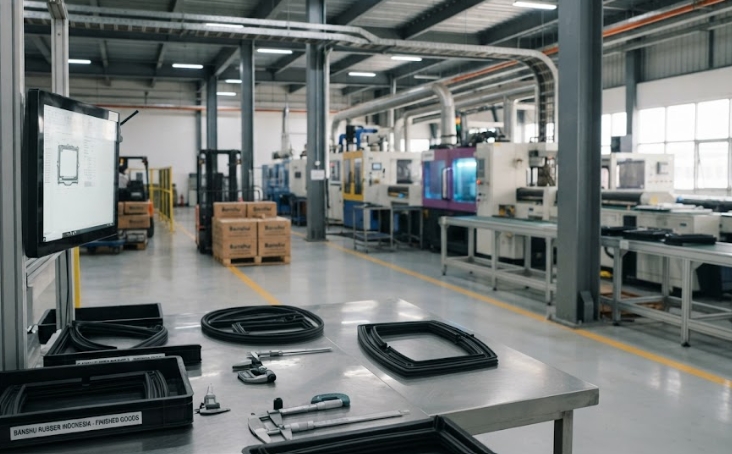
Rubber components are often small compared with the machines and systems they support, but their performance can have a major impact on industrial reliability. Seals, gaskets, vibration isolators, hoses, diaphragms, rollers, bushings, and other rubber components may operate continuously under mechanical loads, temperature changes, chemical exposure, pressure, and repeated deformation.
For this reason, selecting a rubber material based only on hardness or tensile strength is rarely sufficient. The performance of modern industrial rubber depends on how the elastomer, fillers, plasticizers, protective additives, curing system, manufacturing process, and operating environment interact with one another.
This is where rubber formulation becomes an engineering discipline. A compound that performs well in one application may fail quickly in another because the dominant failure mechanism is different. An EPDM compound may perform exceptionally well outdoors but may not be suitable for petroleum based fluids. An NBR compound may provide excellent oil resistance but require additional formulation considerations when exposed to ozone or elevated temperatures.
Understanding these relationships is essential for developing reliable rubber compounds for industrial applications.
Material Selection Is the Foundation of Rubber Compound Performance
The first major factor affecting rubber performance is the selection of the base elastomer.
Natural rubber remains highly valuable in applications where elasticity, fatigue resistance, tear resistance, and dynamic performance are important. One of its engineering advantages is strain induced crystallization. When natural rubber is stretched, parts of its molecular structure can become more ordered, which contributes to resistance against crack growth under certain loading conditions.
This characteristic makes natural rubber useful for vibration isolators, mounts, heavy duty components, and applications involving repeated deformation.
Synthetic elastomers provide a different range of performance characteristics.
EPDM is widely used where resistance to weathering, ozone, water, steam, and elevated temperatures is important. It is commonly found in automotive sealing systems, outdoor components, industrial seals, and applications exposed to environmental aging.
NBR is commonly selected where resistance to petroleum based oils, fuels, and hydraulic fluids is a priority. The acrylonitrile content of the polymer can be adjusted to influence the balance between oil resistance and low temperature flexibility.
Fluoroelastomers provide another option for applications requiring high chemical and thermal resistance. They are often considered when conventional elastomers cannot maintain their properties under aggressive fluids or elevated operating temperatures.
The important engineering principle is that there is no universally superior elastomer. The correct material is the one that provides the required balance of properties under the actual operating conditions.
Rubber Formulation Determines More Than Hardness
Once the base polymer has been selected, the next challenge is developing the rubber formulation.
A rubber compound is a carefully balanced system consisting of elastomer, reinforcing fillers, plasticizers, processing aids, protective chemicals, and curing ingredients. Changing one component can influence several compound properties simultaneously.
Carbon black is one of the most important reinforcing fillers used in industrial rubber. It can increase tensile strength, tear resistance, abrasion resistance, and hardness while also influencing electrical properties and compound viscosity.
Silica provides another reinforcement technology. Depending on the polymer and coupling system, silica can be used to modify mechanical performance, dynamic properties, and other characteristics required for specialized applications.
However, adding more filler does not automatically produce a better compound.
Higher filler loading can increase strength and hardness while also increasing viscosity and reducing flexibility. Excessive reinforcement may make the compound more difficult to process and can negatively influence fatigue performance in some applications.
This is why experienced compound engineers focus on balance rather than maximizing individual properties.
Plasticizers provide another example. They can improve flexibility and processing behavior, particularly at lower temperatures. However, an inappropriate plasticizer may migrate, extract into surrounding fluids, or reduce long term stability.
The final compound properties are therefore determined by the interaction between ingredients rather than by any single raw material.
Additive Dispersion Can Be Just as Important as Additive Selection
A formulation can contain the correct ingredients and still produce poor performance if those ingredients are not properly dispersed.
During rubber mixing, fillers and chemical additives must be distributed throughout the polymer matrix. Poor dispersion can create localized concentrations of filler or curing chemicals. These areas may behave differently from the surrounding material and can become initiation points for cracks or other forms of failure.
This is particularly important in components exposed to cyclic loading.
From an engineering perspective, visual appearance is not enough to determine dispersion quality. A compound can appear smooth and uniform while still containing microscopic agglomerates that affect fatigue and mechanical performance.
The mixing process therefore becomes part of the formulation itself.
Rotor speed, mixing time, temperature, fill factor, ram pressure, ingredient sequence, and equipment condition can all influence dispersion. A well designed formulation must also be compatible with the available mixing technology.
This is why rubber compounds should not be developed independently from the manufacturing process. Material chemistry and process engineering need to be considered together.
Vulcanization Controls the Final Rubber Structure
Before curing, rubber compounds are relatively soft and processable. Vulcanization creates crosslinks between polymer chains and transforms the compound into an elastic network capable of maintaining its shape and mechanical properties.
The curing system therefore has a major influence on final compound performance.
Sulfur curing is widely used because it can provide an effective balance of elasticity, strength, fatigue resistance, and processing efficiency. Different sulfur cure systems can produce different crosslink structures, which influence properties such as heat resistance, compression set, and dynamic behavior.
Peroxide curing can provide improved thermal stability for selected elastomer systems and applications. It can be particularly useful when long term exposure to elevated temperatures is a primary concern.
However, selecting a curing system is not simply a choice between sulfur and peroxide.
The engineer must consider the polymer, filler system, target hardness, operating temperature, dynamic loading, compression set requirements, and downstream manufacturing conditions.
Cure temperature and cure time are equally important. Under curing can leave the compound with insufficient crosslink density, while excessive curing can alter the network structure and negatively influence certain mechanical properties.
The objective is to establish a stable curing window that produces consistent properties across every production batch.
Operating Temperature Can Change the Entire Performance Profile
Temperature is one of the most influential factors affecting industrial rubber.
At low temperatures, elastomers become progressively less flexible as molecular mobility decreases. If the temperature falls below the compounds glass transition region, the material can become significantly harder and more brittle.
At elevated temperatures, oxidation, thermal degradation, plasticizer migration, and changes in crosslink structure can become increasingly important.
The effect of temperature also depends strongly on the polymer.
EPDM is generally well suited to applications involving elevated temperatures and environmental exposure. NBR can provide good performance at moderate to elevated temperatures when properly formulated, although the specific polymer grade and compound design determine its actual service capability.
For high temperature applications, engineers may modify the curing system and antioxidant package to improve long term stability.
The key consideration is not simply the highest temperature a material can tolerate for a short period. Industrial components often experience continuous exposure, temperature cycling, compression, and mechanical deformation simultaneously.
A compound that survives a short laboratory exposure may behave very differently after thousands of hours in actual service.
Mechanical Fatigue Is a Major Cause of Rubber Failure
Industrial rubber components frequently fail because of repeated deformation rather than a single extreme load.
Every time a rubber component is compressed, stretched, twisted, or flexed, mechanical energy is introduced into the material. Repeated cycles can gradually initiate microscopic damage that eventually develops into visible cracks.
Fatigue behavior depends on polymer structure, filler reinforcement, crosslink density, temperature, strain amplitude, crack growth resistance, and manufacturing quality.
Natural rubber can provide excellent fatigue resistance in many dynamic applications because of its strain induced crystallization behavior. Synthetic elastomers may require different reinforcement and cure strategies to achieve the required fatigue performance.
The way the component is loaded also matters.
A component operating under relatively constant deformation may require a different formulation strategy from one experiencing highly variable mechanical loads. Engineers therefore need to understand whether an application is primarily controlled by load, displacement, pressure, or repeated strain.
This information should be considered during compound development rather than after the rubber component has already entered production.
Chemical Exposure Can Change Compound Properties
Industrial rubber often comes into direct contact with chemicals, oils, fuels, cleaning agents, coolants, hydraulic fluids, or process chemicals.
When an elastomer absorbs a liquid, it may swell, soften, harden, lose tensile strength, or experience changes in volume. The severity of the effect depends on both the rubber chemistry and the chemical environment.
NBR is often selected for oil resistant applications because its polymer structure provides good resistance to many petroleum based fluids. However, chemical compatibility must still be evaluated for the exact fluid, temperature, exposure duration, and operating pressure.
EPDM provides excellent resistance to water and many environmental conditions but is generally not the first choice for petroleum based oils and fuels.
This distinction becomes particularly important in industrial equipment where multiple fluids may be present.
For example, a seal used in hydraulic equipment may be exposed not only to hydraulic oil but also to cleaning chemicals, moisture, elevated temperature, and pressure cycling. A formulation that performs well against the primary fluid may still fail because of another environmental factor.
Chemical compatibility testing should therefore reflect the actual service environment rather than relying only on generic material ratings.
Environmental Exposure Can Accelerate Rubber Aging
Ozone, oxygen, ultraviolet radiation, moisture, and heat can gradually change the structure of rubber.
Ozone is particularly damaging to susceptible elastomers under tensile strain. Small surface cracks can develop and grow over time, eventually compromising sealing performance.
Antiozonants and antioxidants are therefore important components in many industrial rubber formulations.
Protective waxes can also provide physical protection by migrating toward the rubber surface and reducing exposure to ozone.
The effectiveness of this protection depends on formulation design and operating conditions. Excessive or insufficient levels of protective additives can affect processing behavior and long term performance.
For outdoor applications, engineers often consider weathering as a combined problem involving ultraviolet radiation, ozone, oxygen, temperature cycling, moisture, and mechanical deformation.
This is why a weather resistant rubber compound should be evaluated under conditions that resemble the actual service environment as closely as possible.
Pressure and Deformation Influence Compound Design
Pressure can significantly influence rubber performance, particularly in seals, hoses, diaphragms, and hydraulic components.
Under compression, rubber must maintain sufficient contact force to prevent leakage without experiencing excessive permanent deformation.
Compression set is therefore an important compound property for many sealing applications. A material with poor compression set resistance may gradually lose its ability to maintain sealing pressure after prolonged compression.
High pressure applications introduce additional concerns, including extrusion, rapid decompression, and dimensional instability.
The formulation must be considered together with component geometry, hardness, operating temperature, pressure, and installation conditions.
This demonstrates why material selection cannot be separated from product design. A technically excellent elastomer can still fail if the compound and component geometry are not engineered together.
Quality Testing Validates the Rubber Compound
Laboratory testing provides the evidence required to confirm that a rubber formulation can deliver the intended performance.
Tensile strength and elongation provide fundamental information about mechanical behavior. Hardness helps confirm material consistency and provides an initial indication of stiffness.
Abrasion testing is important for components exposed to continuous rubbing or sliding contact. Compression set testing is essential for many sealing applications. Tear resistance can be critical where components contain sharp edges, thin sections, or repeated deformation.
For more demanding applications, engineers may perform dynamic mechanical analysis, fatigue testing, aging tests, fluid immersion testing, and crack growth evaluation.
The purpose of testing is not simply to generate a certificate. Testing should help engineers understand how the compound behaves and why it behaves that way.
Advanced microscopy and fracture analysis can also provide valuable information when investigating failures. Examining the fracture surface may reveal filler agglomeration, contamination, voids, poor bonding, or other manufacturing related issues.
This type of analysis is especially valuable when developing custom elastomer compounds for demanding industrial applications.
ASTM and ISO Standards Support Consistent Evaluation
International standards provide a common framework for evaluating rubber materials.
ASTM and ISO test methods allow manufacturers and customers to compare compound properties using consistent testing procedures. This is particularly important for international supply chains where materials may be manufactured in one country and used in another.
However, compliance with a test standard does not automatically guarantee that a compound is suitable for every application.
A rubber compound can meet a specific tensile strength requirement while still performing poorly under long term chemical exposure or cyclic fatigue.
Experienced engineers therefore treat standards as part of the validation process rather than as the entire definition of product performance.
The most reliable approach combines standardized laboratory testing with application specific validation.
Why Custom Rubber Compounds Often Deliver Better Industrial Performance
Industrial applications rarely operate under identical conditions.
Two seals may have the same hardness and similar dimensions but require completely different formulations because one is exposed to oil while the other operates outdoors under ozone and ultraviolet radiation.
This is where custom rubber compounds provide significant value.
A custom formulation allows engineers to optimize the polymer, filler system, plasticizer, protective package, and curing system around the actual application.
The objective is not to create the strongest rubber possible. The objective is to create the most appropriate rubber for the application.
This approach can also improve manufacturing efficiency. A compound with the correct viscosity and cure characteristics can reduce processing variation, improve molding consistency, and reduce production waste.
For OEMs and industrial buyers, this means compound development should be treated as an engineering partnership rather than simply a material purchasing decision.
The performance of modern rubber compounds is determined by a complex interaction of material chemistry, formulation, manufacturing process, and operating environment.
Selecting the correct elastomer is the starting point, but it is only one part of the engineering process. Reinforcing fillers influence strength and fatigue behavior. Plasticizers affect flexibility and processability. Protective additives improve resistance to aging. The curing system determines the structure of the final polymer network. Mixing and vulcanization determine whether the designed formulation can actually be reproduced consistently in production.
Industrial rubber components must also be designed around their real operating conditions. Temperature, chemicals, pressure, cyclic deformation, ozone, ultraviolet radiation, and mechanical stress can interact in ways that cannot always be predicted from a single laboratory test.
For this reason, successful rubber formulation requires a combination of material science, process engineering, laboratory testing, and practical manufacturing experience.
At Banshu Rubber, our approach to elastomer compounds is based on understanding the complete application rather than selecting materials from a standard catalog. By combining formulation expertise, controlled rubber mixing, precision manufacturing, and quality validation, we help customers develop industrial rubber solutions that deliver consistent compound properties and reliable performance in demanding operating environments.
When the application is complex, the rubber compound should be engineered with the same level of precision as the component itself.