
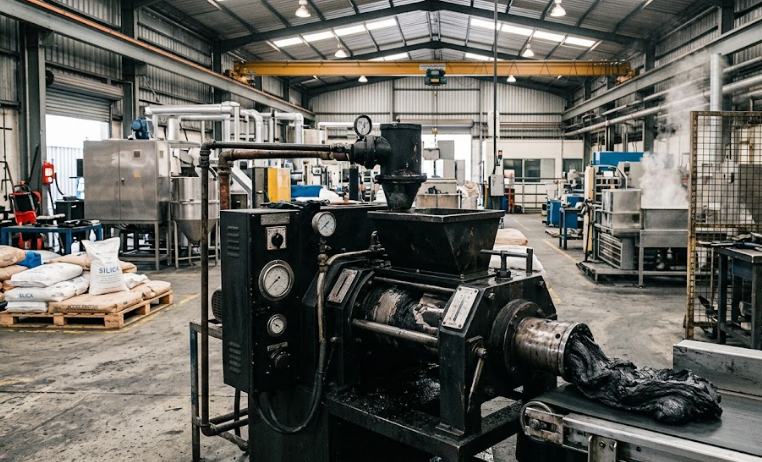
Not every rubber product is expected to perform under ideal conditions. Many components operate in environments where they are continuously exposed to extreme heat, freezing temperatures, ultraviolet radiation, ozone, aggressive chemicals, hydraulic fluids, fuels, seawater, or abrasive mechanical stress. In these applications, selecting the wrong material often leads to premature cracking, swelling, hardening, loss of elasticity, or sealing failure long before the product reaches its intended service life.
This is why rubber compound formulation is one of the most critical engineering disciplines in modern rubber manufacturing. Developing a compound for harsh environments requires far more than choosing a high-performance elastomer. It demands a deep understanding of polymer chemistry, filler interactions, curing systems, processing behavior, and the environmental conditions the finished product will encounter throughout its lifecycle.
From an engineering perspective, successful formulations are not built around the strongest material. They are designed around the right balance of properties. Every adjustment made to improve one characteristic may influence another. Increasing heat resistance, for example, may reduce flexibility. Improving chemical resistance may affect compression set. The challenge is finding the optimum balance rather than maximizing a single property.
Designing a Rubber Compound Starts with Understanding the Environment
One of the most common mistakes in rubber product development is selecting a material before fully understanding the application.
Harsh environments vary considerably across industries. An automotive door seal experiences continuous ultraviolet exposure, rain, ozone, and seasonal temperature changes. A hydraulic seal inside industrial machinery may never see sunlight but must withstand hot oil under constant pressure. Oil and gas equipment often encounters drilling fluids containing hydrocarbons, additives, saltwater, and abrasive particles simultaneously.
Although these applications are all considered harsh environments, they create completely different engineering challenges.
Experienced compound engineers begin every rubber compound formulation by identifying the dominant degradation mechanisms. Instead of asking which rubber is strongest, they ask which environmental factors will cause failure first. The answer determines the selection of elastomers, fillers, protective additives, and curing technology.
Every High Performance Compound Relies on Five Essential Building Blocks
Every rubber compound is built around five fundamental components that work together as a complete engineering system.
The elastomer forms the structural foundation and largely determines flexibility, chemical resistance, weatherability, and operating temperature.
Reinforcing fillers such as carbon black or silica improve tensile strength, tear resistance, abrasion resistance, and dimensional stability. However, filler selection is not simply about increasing strength. Particle size, structure, and surface chemistry all influence how the filler interacts with the polymer network.
Plasticizers control compound processability while improving flexibility at low temperatures. Selecting an incompatible processing oil, however, may reduce long term durability or accelerate extraction when exposed to chemicals.
Protective agents such as antioxidants and antiozonants slow the natural aging process caused by oxygen, ozone, heat, and ultraviolet radiation. Without these additives, even premium polymers gradually lose their mechanical properties during service.
Finally, the curing system transforms the uncured compound into an elastic three dimensional network capable of maintaining its shape under repeated deformation.
Rather than optimizing each ingredient independently, experienced engineers evaluate how every component interacts with the others. The final performance always depends on the complete formulation rather than any individual raw material.
This systems based approach is why custom compounds consistently outperform standard formulations in demanding industrial applications.
Choosing Between EPDM Compound and NBR Compound
Among the many elastomers available today, EPDM and NBR remain two of the most widely specified materials for harsh operating environments.
An EPDM compound is widely recognized for its exceptional resistance to weathering. It performs extremely well under prolonged exposure to ultraviolet radiation, ozone, moisture, and elevated temperatures, making it the preferred material for automotive weatherstrips, construction seals, electrical insulation, and outdoor industrial equipment.
One reason for its outstanding durability is its molecular structure. Because EPDM contains a highly saturated polymer backbone, it is naturally less vulnerable to oxidation and ozone attack than many general purpose elastomers. As a result, products manufactured from properly formulated EPDM often maintain flexibility and sealing performance after years of outdoor exposure.
An NBR compound, on the other hand, is engineered for environments where oils, fuels, lubricants, and hydraulic fluids present the greatest challenge.
The nitrile groups within the polymer structure reduce swelling when exposed to petroleum based fluids, making NBR a preferred choice for hydraulic seals, O rings, fuel hoses, and oilfield equipment.
However, experienced engineers understand that chemical resistance is never absolute.
For example, two hydraulic fluids may appear similar while producing completely different effects on an NBR seal. Aromatic hydrocarbons, synthetic esters, aggressive drilling additives, or mixed chemical environments can significantly influence swelling behavior, hardness retention, and long term durability.
Rather than selecting NBR based solely on its reputation for oil resistance, engineers often adjust acrylonitrile content, reinforcing fillers, and curing chemistry to improve compatibility with the actual chemicals present in the application.
This illustrates an important principle in rubber engineering. Material selection should always be based on the complete operating environment rather than a single material property.
Building Weather Resistant Rubber for Outdoor Applications
Developing weather resistant rubber requires much more than selecting an EPDM compound.
Outdoor degradation occurs through several mechanisms simultaneously. Ultraviolet radiation gradually breaks molecular bonds. Ozone attacks stretched rubber surfaces, creating microscopic cracks that eventually propagate into visible failures. Oxygen accelerates oxidation, while heat speeds nearly every degradation reaction occurring inside the polymer.
Because these mechanisms work together, protection must also be designed as an integrated system.
Antioxidants reduce thermal oxidation by interrupting free radical reactions within the polymer network.
Antiozonants provide chemical protection against ozone attack before molecular chains begin to crack.
Protective waxes contribute another layer of defense. As the rubber ages, these waxes slowly migrate toward the surface and form a thin protective barrier that limits ozone exposure.
Rather than viewing these additives individually, experienced formulation engineers optimize their combined performance. Proper synergy between antioxidants, antiozonants, and protective waxes often delivers significantly longer service life than increasing the concentration of a single additive.
This balanced approach becomes particularly valuable for automotive weather sealing systems that must maintain flexibility through years of sunlight, rain, humidity, freezing winters, and summer heat.
Why the Cure System Matters as Much as the Polymer
Many discussions about rubber performance focus almost entirely on polymer selection.
In practice, the curing system often determines whether the compound succeeds or fails under extreme temperatures.
Sulfur curing remains the most common crosslinking technology because it provides excellent mechanical properties while supporting economical production. For many general purpose applications, sulfur cured compounds offer an ideal balance between flexibility and manufacturing efficiency.
However, continuous exposure to elevated temperatures gradually weakens sulfur crosslinks.
For applications operating under severe thermal conditions, peroxide curing frequently provides superior long term stability.
Peroxide generated carbon carbon crosslinks exhibit greater thermal resistance and improved compression set performance, making them particularly suitable for many EPDM compound applications requiring extended service at high temperatures.
Choosing peroxide does not automatically produce a better compound.
Higher peroxide loading may improve heat resistance while simultaneously increasing stiffness and reducing flexibility. Excessive crosslink density may also decrease dynamic fatigue performance.
This is why optimization involves carefully adjusting peroxide concentration until thermal stability, elasticity, and processing characteristics reach the desired balance rather than simply maximizing cure density.
Fine Tuning the Rubber Compound Formulation
Developing successful custom compounds usually follows two distinct stages.
The first stage focuses on establishing the technical foundation.
Engineers select the base polymer, identify target hardness, determine filler technology, evaluate the curing system, and confirm that the formulation can be processed efficiently using available manufacturing equipment.
The second stage involves optimization.
Instead of redesigning the formulation, engineers make controlled adjustments measured in parts per hundred rubber, commonly referred to as phr.
Reducing filler loading may improve flexibility while lowering hardness.
Increasing reinforcing filler may improve abrasion resistance but also increase compound viscosity during mixing.
Changing processing oil content may improve manufacturability while affecting tensile strength and compression set.
These adjustments appear relatively small on paper, yet they often determine whether a compound successfully meets customer specifications.
The mixing sequence also deserves careful attention.
Protective additives and specialty chemicals must be dispersed uniformly throughout the compound to achieve consistent long term performance. Poor dispersion may create localized regions where protective chemistry is insufficient, leading to premature aging despite using the correct formulation.
For experienced compound engineers, optimization is therefore not a single calculation. It is an iterative process involving laboratory testing, production trials, and continuous refinement until technical performance and manufacturing cost reach the optimum balance.
Innovation Is Reshaping Rubber Compound Development
Modern rubber formulation is evolving beyond conventional material selection.
Nanotechnology is enabling finer control over reinforcement by improving filler interaction with the polymer matrix. Advanced silica systems, functionalized polymers, and hybrid nanomaterials continue to improve mechanical performance without dramatically increasing compound weight.
Sustainability is also becoming an important consideration.
Manufacturers increasingly evaluate renewable processing oils, recycled reinforcing materials, and environmentally responsible additives while maintaining demanding performance requirements.
At the same time, digital quality control is transforming production consistency.
Laboratory testing now extends well beyond traditional hardness and tensile measurements. Compound viscosity, cure characteristics, filler dispersion, dynamic mechanical behavior, and aging performance are routinely monitored to verify that every production batch behaves consistently before entering full scale manufacturing.
These innovations allow manufacturers to produce rubber compounds capable of surviving increasingly demanding operating environments while maintaining consistent quality across high volume production.
Optimizing a rubber compound formulation for harsh environments requires a comprehensive engineering approach rather than simply selecting a premium elastomer.
The most successful formulations begin with a clear understanding of the operating environment. From there, engineers carefully select the appropriate polymer, optimize reinforcing fillers, develop a balanced protection system against heat and weathering, and choose a curing technology that delivers the required long term performance.
Whether developing an EPDM compound for outdoor weather sealing or an NBR compound for aggressive industrial fluids, every application requires its own formulation strategy. There is no universal solution because every operating environment introduces a different combination of thermal, mechanical, and chemical challenges.
For manufacturers seeking maximum reliability, investing in well engineered custom compounds often delivers greater long term value than relying on standard formulations. By combining material science, process engineering, and rigorous validation, manufacturers can develop weather resistant rubber products that continue to perform even in the most demanding service conditions.
Banshu Rubber: Engineering Custom Rubber Compounds for Demanding Applications
At Banshu Rubber, we believe every successful rubber product begins with a precisely engineered rubber compound formulation. Our engineering team develops custom compounds tailored to the specific environmental, mechanical, and chemical demands of each application, ensuring consistent performance from prototype development through high volume production.
Whether your project requires a weather resistant EPDM compound for outdoor applications, an NBR compound for oil and fuel resistance, or a specialized formulation for demanding industrial environments, Banshu Rubber combines advanced compounding technology, strict quality control, and manufacturing expertise to deliver reliable rubber solutions that meet global industry standards.