
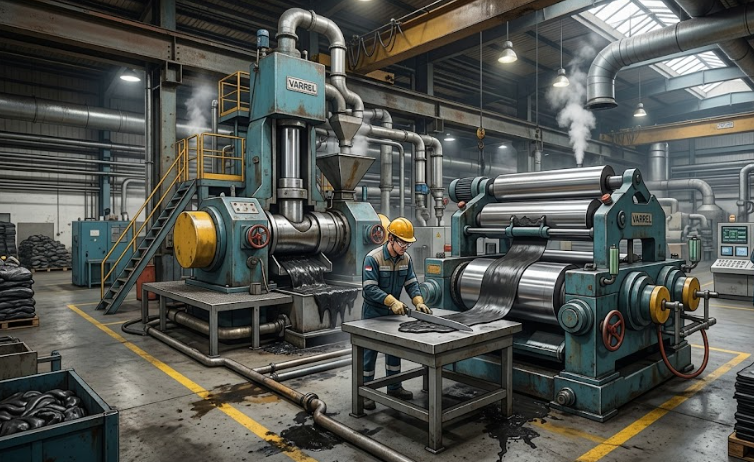
In rubber manufacturing, product quality is rarely determined during molding or curing. It is determined much earlier, during the rubber mixing stage. A perfectly designed mold cannot compensate for a poorly mixed rubber compound, just as premium raw materials cannot deliver consistent performance without proper dispersion. This is why experienced rubber engineers often describe mixing as the foundation of every successful rubber product.
When manufacturers evaluate a new production line or expand their production capacity, one question almost always arises. Should they invest in an open mill or a Banbury mixer. Both machines are capable of producing rubber compounds, yet they are designed for very different production objectives. The right decision depends on much more than production capacity. It involves understanding material behavior, process stability, operating costs, maintenance requirements, and long term manufacturing goals.
For manufacturers serving the automotive, industrial machinery, electronics, or heavy equipment industries, selecting the appropriate rubber mixing method can significantly influence product consistency, production efficiency, and customer satisfaction.
Understanding the Difference Between Open Mill and Banbury Mixer
The open mill is one of the oldest pieces of equipment still widely used in modern rubber manufacturing. Its design is straightforward. Two steel rolls rotate toward each other at slightly different speeds, creating shear force that gradually blends the polymer with fillers and additives. Because the rubber remains visible throughout the process, operators can continuously observe how the material behaves while making adjustments whenever necessary.
Although the equipment appears simple, operating an open mill requires considerable experience. Skilled compound engineers can recognize subtle changes in the appearance of the rubber sheet, the way it wraps around the rolls, or even its surface texture. These observations often reveal whether fillers are dispersing correctly or whether the compound is beginning to generate excessive heat.
The Banbury mixer follows a completely different engineering philosophy. Instead of relying on manual observation, the entire mixing process occurs inside an enclosed chamber where two specially designed rotors generate extremely high shear energy. Hydraulic pressure continuously forces the compound against the rotating rotors, allowing fillers to disperse much faster and more uniformly than on an open mill.
Modern Banbury mixers also monitor rotor speed, chamber pressure, mixing energy, and temperature throughout the entire cycle. Rather than depending on operator judgment alone, the machine follows predetermined processing parameters that improve repeatability from one batch to the next.
This evolution from open mixing to enclosed internal mixing reflects the growing demand for higher productivity, tighter quality control, and greater manufacturing consistency.
Rubber Mixing Is More Than Simply Blending Ingredients
Many people assume that rubber mixing simply combines raw materials until they appear uniform. In reality, the process is far more complex.
A rubber compound contains base polymers, reinforcing fillers, processing oils, antioxidants, curing agents, accelerators, and numerous specialty additives. Each ingredient enters the formulation for a specific purpose, and every ingredient interacts differently under shear and temperature.
From an engineering perspective, the objective is not merely to mix materials together. The real objective is to create a stable microscopic structure where every filler particle is evenly dispersed throughout the polymer network.
Carbon black provides an excellent example. Before mixing, carbon black exists as microscopic agglomerates that naturally cling together. If these clusters remain intact, they create weak points inside the finished product. Even when the compound appears visually smooth, poor dispersion can reduce tensile strength, fatigue resistance, and sealing performance.
Generating enough shear energy to separate these agglomerates without damaging the polymer chains is one of the greatest challenges in the rubber compounding process. This balance explains why rubber mixing is often described as both an engineering discipline and a manufacturing art.
Why Banbury Mixer Dominates High Volume Rubber Manufacturing
For manufacturers producing thousands of components every day, consistency is just as important as production speed.
The Banbury mixer excels because it creates an enclosed environment where nearly every processing parameter can be controlled. Rotor geometry, chamber pressure, fill factor, mixing time, and cooling capacity work together to produce predictable results.
One important advantage is filler dispersion. High shear generated by the rotating rotors breaks down carbon black and silica agglomerates much more efficiently than manual mixing methods. Better dispersion improves mechanical properties while reducing variation between production batches.
Another significant advantage is process repeatability. Automotive manufacturers, for example, require every rubber seal to perform identically regardless of whether it was produced today or several months later. A slight variation in compound viscosity or filler distribution may lead to dimensional instability, premature cracking, or inconsistent compression set.
Because the Banbury mixer operates according to predefined processing recipes, manufacturers can achieve remarkably consistent compound quality across continuous production schedules.
This consistency becomes especially valuable when processing engineering elastomers such as EPDM and NBR for demanding applications where even small process variations may affect long term product performance.
Why Open Mill Continues to Play an Important Role
Despite the growing popularity of internal mixers, the open mill remains indispensable in many manufacturing facilities.
One reason is flexibility. During formulation development, engineers often need to evaluate how new additives influence compound behavior. On an open mill, they can immediately observe changes in elasticity, surface appearance, band formation, and processability while adjusting ingredient additions in real time.
This direct interaction with the material provides valuable information that automated sensors cannot always capture.
Another important application is the final mixing stage.
In many factories, the Banbury mixer prepares the masterbatch by combining the polymer with reinforcing fillers and processing aids. Heat sensitive ingredients such as sulfur and accelerators are intentionally excluded during this stage because excessive temperatures may initiate premature crosslinking.
After the masterbatch cools, it moves to an open mill where curing agents are incorporated under lower temperature conditions. This approach minimizes the risk of scorching while allowing operators to verify compound quality before extrusion or molding.
Rather than competing with one another, the Banbury mixer and the open mill often work together as complementary stages within the same rubber compounding process.
Engineering Considerations Beyond Production Speed
Choosing mixing equipment should never be based solely on production capacity.
Material viscosity is one factor that deserves careful consideration. Highly filled compounds containing large amounts of carbon black require greater dispersive energy, making the Banbury mixer a more effective solution. Softer compounds or specialty formulations developed in smaller quantities often benefit from the flexibility of an open mill.
Heat generation is another critical factor.
As rubber experiences continuous shear, friction converts mechanical energy into heat. While sufficient heat improves filler incorporation, excessive temperatures may degrade the polymer or initiate premature curing.
Experienced process engineers therefore monitor dump temperature very carefully. The target temperature depends on the polymer system, filler loading, and curing chemistry. Reaching a higher temperature does not necessarily indicate better mixing. In many cases, excessive thermal history actually reduces compound stability during downstream processing.
This is one reason why successful rubber manufacturing depends on understanding process windows rather than simply maximizing machine performance.
Maintenance Influences Long Term Performance
Equipment condition directly affects compound quality.
On an open mill, worn roll surfaces may reduce shear efficiency and create inconsistent sheet thickness. Poor roll alignment can also influence material flow, making dispersion less uniform across the width of the compound.
The Banbury mixer presents different maintenance challenges.
Rotor tips gradually wear after thousands of production cycles. As clearances increase, the amount of effective shear decreases. The result may not be immediately visible, yet laboratory testing often reveals changes in Mooney viscosity, filler dispersion, or curing characteristics.
Rotor seals also require regular inspection because leakage reduces chamber efficiency while increasing maintenance costs.
Many manufacturers focus on production output while overlooking equipment wear. In practice, preventive maintenance often has a greater influence on compound consistency than increasing rotor speed or extending mixing time.
Looking Beyond Equipment Cost
At first glance, an open mill appears to be the more economical investment because its purchase price is considerably lower.
However, experienced manufacturing engineers evaluate equipment differently.
The true cost of rubber mixing includes labor, production efficiency, energy consumption, quality losses, maintenance, and production downtime.
For companies producing relatively small batches or developing new formulations, an open mill usually provides the best economic value because it offers flexibility without requiring a large capital investment.
As production volume increases, the economics begin to change.
A Banbury mixer can process larger batches with fewer operators while maintaining highly consistent quality. Reduced material waste, lower batch variation, and higher throughput gradually offset the initial investment.
For manufacturers supplying automotive OEMs or industrial customers with continuous production schedules, the long term return on investment often becomes significantly greater than the purchase price alone would suggest.
The Future of Rubber Mixing
The next generation of rubber manufacturing is becoming increasingly intelligent.
Modern mixing systems already integrate sensors capable of monitoring torque, energy consumption, chamber temperature, and mixing behavior in real time. Artificial intelligence is beginning to analyze these production data to identify process deviations before they affect product quality.
Predictive maintenance is also changing how factories manage equipment. Instead of waiting for components to fail, manufacturers can estimate rotor wear, bearing condition, and maintenance intervals based on actual operating data.
Sustainability is another driving force behind innovation.
Manufacturers continue to develop cleaner ingredient handling systems that reduce airborne dust while improving workplace safety. More efficient cooling systems and optimized mixing cycles also reduce energy consumption without sacrificing compound quality.
These developments demonstrate that the future of rubber mixing is no longer defined solely by faster production. It is increasingly defined by smarter process control, greater consistency, and more sustainable manufacturing.
Choosing the Right Rubber Mixing Method
There is no universal answer when deciding between an open mill and a Banbury mixer because every manufacturing operation has different priorities.
If your business focuses on research, prototype development, specialty compounds, or low volume production, the open mill remains an excellent solution because it offers unmatched flexibility and direct process control.
If your objective is consistent quality across high volume production with minimal batch variation, the Banbury mixer is generally the preferred choice because it combines automation, repeatability, and superior filler dispersion.
Interestingly, many of the world's leading rubber manufacturers choose not to rely on only one machine. They combine both technologies. The Banbury mixer performs the demanding task of dispersing fillers within the masterbatch, while the open mill completes the final stage by incorporating curing agents under carefully controlled conditions.
This combination reflects an important engineering principle. The best manufacturing process is rarely about choosing one technology over another. It is about selecting the right technology for each stage of the process to achieve the highest level of product quality, manufacturing efficiency, and long term reliability.
Banshu Rubber: Your Trusted Rubber Manufacturing Partner
At Banshu Rubber, we understand that consistent rubber products begin with a consistent rubber compounding process. Our engineering team combines advanced rubber mixing technology, process expertise, and rigorous quality control to develop custom rubber compounds that meet the demanding requirements of automotive, industrial, electronics, and precision manufacturing applications.
From formulation development through high volume production, every compound is engineered to deliver stable processing characteristics, reliable mechanical performance, and repeatable quality. By optimizing material selection, mixing parameters, and process control, Banshu Rubber helps customers achieve greater manufacturing efficiency while ensuring every product performs as intended throughout its service life.
Whether you require a custom compound for a new product or a reliable manufacturing partner for large scale production, Banshu Rubber is ready to support your next project with engineering driven solutions and globally competitive quality.